Systems integrator DWFritz builds automation known for precision and speed. But their new electrode stacking technology went beyond speed and precision. In an industry where every square foot of floor can cost nearly $300 annually, it was the size of the machine that truly mattered, so that’s what I built this campaign around.
The most critical and costly step in battery manufacturing — the handling of lithium and other materials — happens inside a dry room, one of the most expensive environments in all of manufacturing to build and operate. The DWFritz stacker delivers the same 10 GWh of factory output as legacy systems in roughly a third of the footprint. It fundamentally changes the economics of operating a battery plant.
That became the concept: The World's Smallest Gigafactories. A $4.7-million machine is a hard sell when the story repeats the same things every other automation pitch does: work faster, reduce scrap, save labor. Reframing it as something that completely shifts the infrastructure requirements and financial risk associated with battery manufacturing turned a precision-engineering story into a business-transformation one, and gave the campaign its big idea.
I designed a six-month go-to-market campaign, including a content and trade-media strategy to build DWFritz's authority in energy manufacturing; an early-inbound engine to capture interest ahead of launch; and a VIP reveal planned alongside the technology’s public debut at the Detroit Battery Show. The assets below are key parts of the campaign, each one built to carry the same idea at a different moment in the buyer's journey.
The campaign began months before we would be able to reveal the electrode stacker. To begin laying the ground for the launch, we needed a video to introduce DWFritz as an authoritative partner in battery manufacturing automation. The highest performing marketing channel in automation is trade shows, so the video needed to be in a form factor that would catch attention, and include content that would hold it in a loud, crowded environment. In collaboration with our booth designers at Exclaim, we built this video around a 14-foot tall video pillar placed in the leading corner of the DWFritz trade show booth. I was the creative director, wrote the script, and briefed the animated portions. Live action video was shot by Visual+Aid. Animation and video editing were handled by Exclaim.
To accompany the public launch of the electrode stacker, we wanted to create a high-impact digital-physical experience that would instantly drive home the startling difference in size between legacy automation and the DWFritz technology. In partnership with Exclaim, I developed a concept for an animated infographic that would be designed around 3D printed scale models of both the legacy technology and DWFritz’s new solution, which would be fixed in the middle of a 100-inch screen on an angled pedestal. I wrote and directed this video, which first appeared in the DWFritz booth at the Battery Show in Detroit in 2025. The placement of the 3D printed models are indicated by the orange and blue rectangles in the video.
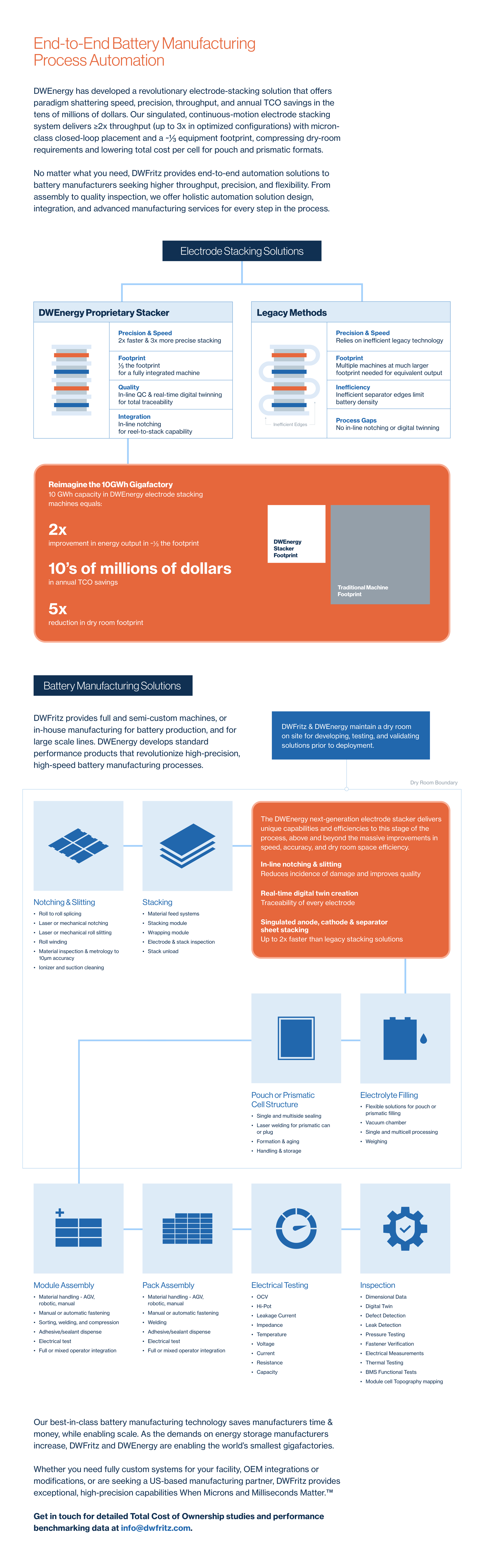
I developed the visual concept and wrote all copy for this infographic, which was originally used on the DWFritz website to explain both their full capabilities in automated battery manufacturing, and also to explain the extraordinary advantages of their new electrode stacking technology versus legacy methods. Infographic design was handled by Plazm.